Microsoft postpones the change for new CSP purchases to January–March 2027. Certain eligible experiences may incur charges beyond license fees, subject to an adjustable monthly limit.
Microsoft · Announcement: · Editorial review
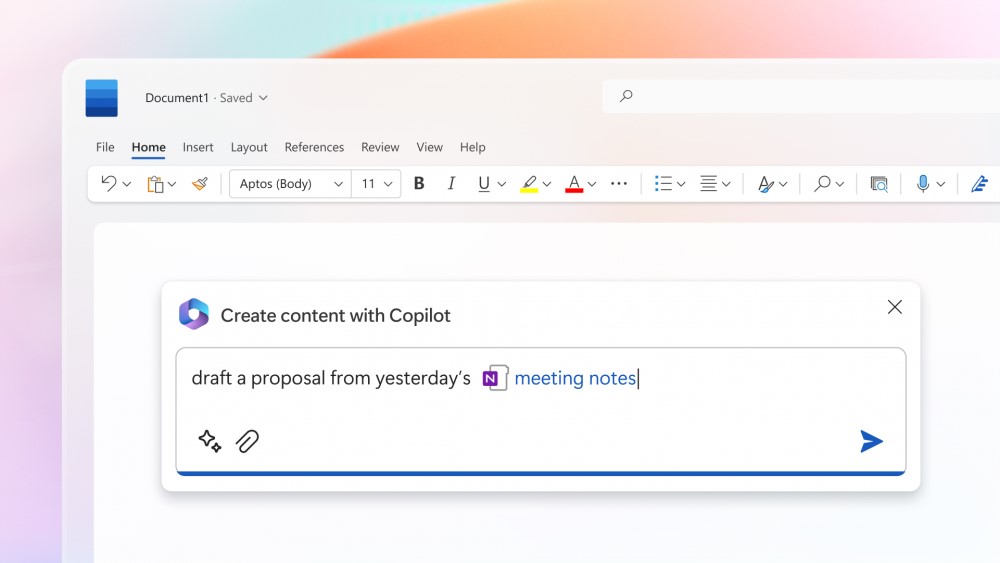
Microsoft 365 Copilot in Microsoft Word (archive). Image: Microsoft. Used with permission from Microsoft.
The change merged into BCApps creates per diem lines in each traveler's new expense report. Its inclusion in the repository does not yet establish deployment to customer environments.
GitHub Enterprise Cloud includes Copilot access for eligible enterprises, without an included credit allowance. Availability depends on the purchasing channel, and metered usage is billed from the first use.
The change replaces mark-based deletion and adds tools to inspect and clean up residual records. Integration into the repository does not yet confirm availability in a shipped Business Central update.
Microsoft has announced bundles of Business Central Essentials or Premium with Microsoft 365 Copilot Business from January 1, 2027. Published prices are USD 95 and USD 125 per user per month; accessible experiences will depend on licensed apps and services.
Microsoft brings equipment rental management into Supply Chain Management, connected with Finance. The documentation provides a basis for examining the process; the Copilot Cowork scenario is presented as a demonstration.
Microsoft extends usage limits to additional Copilot Chat features for users without a Microsoft 365 Copilot license in commercial organizations. The notifications call for support preparation and a review of license requests, without turning every limit into a recommendation to buy.
The API supports reading and updating policies across enterprises, organizations, teams, and agent apps. Using it requires identifying who controls each decision and reviewing changes.
The instructions guide compatible coding assistants. Evaluating them requires checking installation scope, project dependencies, and the changes they generate.
Apple opens app action integration through App Intents. For developers in Spain, Siri AI availability on Mac and Vision Pro sits alongside its absence on iPhone, iPad, and Apple Watch.
A change merged into BCApps allows an interim approver to be configured while an expense report is Released, before submission for approval. Deployment to customers is unconfirmed.
BCApps adds placeholders that let test inputs reuse identifiers generated during setup. The change has been merged into the repository; the consulted sources do not establish availability in a shipped release.
A change merged into BCApps lets extensions modify consolidation filters before the standard request. Its usefulness depends on the fields and operators supported by the API.
Two fixes merged into the repository affect posting group changes after acquisition and document numbering for cancellations. Their value for financial review depends on configuration and the installed version.
A correction merged into BCApps aims to preserve historical balances when foreign-currency payments are unapplied. Period-end tests need to check each reporting date as well as the overall balance.
A correction merged into BCApps preserves ErrorInfo in two interactive error handlers. Effective navigation and availability in customer environments remain unconfirmed.
The change prevents certain cancellation-date calculations from shifting to month-end. Stored dates require recalculation, and delivery to customers has not been confirmed.
Public sources checked on November 7, 2026: issue, merge, code, tests and functional documentation. The correction is associated with the 30.0 milestone; a distributed update containing it has not been established. Nexo has not run the tests or examined customer environments.
BCApps merged a Subscription Billing correction concerning cancellation deadlines into its main branch on October 23. The merge is recorded in pull request #10444.
The original issue describes a line starting on January 1, 2026, with a 12-month initial term and 60 days’ notice. The term ended on December 31, but the cancellation deadline appeared as November 30 instead of November 1. A subsequent month-end adjustment changed the subtraction result.
The fields serve different purposes: Cancellation Possible Until indicates the deadline for timely cancellation; Term Until specifies the minimum billing term. Subscription Line End Date determines when billing ends and is independent of those two dates, according to Microsoft’s functional documentation.
What changes in the calculation
The Subscription Line code makes month-end alignment conditional in three paths: calculating the cancellation deadline, reconstructing the term end when that deadline is entered, and extending the term through Extension Term, displayed as Subsequent Term.
The new formula classifier retains alignment for months, quarters and years. It also accepts combinations such as 1Y+6M; a composite formula containing days or weeks is excluded from that alignment.
Three documented comparison cases
These synthetic inputs come from the tests added to the repository. They are expected results in code, not measurements made by Nexo. All three lines have a 12M initial term and subsequent term. Dates use year-month-day format.
Start date and notice
Term Until
Cancellation Possible Until
2026-01-01 · 60D (60 days)
2026-12-31
2026-11-01
2026-01-01 · 4W (4 weeks)
2026-12-31
2026-12-03
2025-03-01 · 1M (1 month)
2026-02-28
2026-01-31
Stored dates need a separate review
The commit includes no data upgrade code: stored dates remain unchanged until their next recalculation.
Nexo’s functional interpretation is that comparing two lines’ formulas alone is insufficient. It is also useful to record when their dates were calculated and which operation produced the observed result.
Microsoft documents the Update Subscription Line Dates action and its automation through codeunit 8058. That documentation describes date updates; it does not establish a general migration of values affected by this defect.
Nexo’s proposed functional review
Once a build containing the change is available, we propose the following checks in a test environment. This is editorial guidance, not a validation already performed.
Record the Business Central and Subscription Billing versions, work date and installed extensions.
Prepare synthetic lines with daily, weekly and monthly notice periods, including term ends both at month-end and on other dates.
Compare an existing line before recalculation, that same line after recalculation, and a new line with identical settings.
Also check manual entry of the cancellation deadline and term extension; record the operation performed and the before-and-after values.
Agree acceptance criteria for each scenario before deciding which real records require intervention.
Availability: merge confirmed, distribution not established
The pull request is assigned to the Version 30.0 milestone, described as Business Central online 2027 release wave 1, with no due date specified. This is a planning reference; the consulted sources do not identify a distributed update that would establish the fix as installed.
The author reports 40 successful tests in codeunit 148156 inside a BC 29 container. That validation reported in the commit does not demonstrate that a commercial BC 29 update contains the change. Nexo has reviewed the public sources but has not repeated that execution.
Created with AI assistance and reviewed by Nexo Community. Practical proposals and editorial interpretation are distinguished from documented facts.