A Microsoft reference architecture guides the design of internal support with Copilot Studio. Permissions, escalation, and testing shape what is worth automating.
Business Central 29 combines controls over selectable layouts with APIs for querying the report inbox, retrieving files and updating their read status.
Microsoft lists three enhancements in public preview: multiple excise duties per item, withholding on employee transactions and vendor-specific self-billing number series. Their application depends on the process and configuration.
BC29 adds purchase order instructions, assisted setup and new warehouse options for subcontracting, building on capabilities already available in 28.3.
GitHub adds optional comparisons to the Copilot impact dashboard. The indicators place adoption and pull request merge rates alongside participating peers, with limits worth understanding before setting targets.
OpenAI’s policies will require prior approval to give third parties direct access to its models from November 20, 2026. The text distinguishes this service from integrating models into an application.
BC29 brings together data-driven AL tests, command-line execution and Page Scripting. A fictional example explores their combined use, including version and environment limitations.
Documentary review: 27 October 2026. The registered videos could not be accessed; factual statements rely on the linked public documentation. The example is fictional and has not been executed. We have no independent coverage or productivity measurements.
The official update 29.0 notes list extensible, data-driven AL test suites, command-line and CI/CD test execution, and Page Scripting as generally available. For existing online customers, administrators schedule the update within a window ending in February 2027; the announcement does not establish that a particular environment already runs BC29.
Reusable data and test lifecycle in AL
The AL testing guide documents TestDataSource for running a method with multiple contexts supplied by a codeunit implementing ITestDataSource. Each case has a stable identifier. TestHandlers and ITestHandler provide shared test lifecycle callbacks, for example for logging or cleanup.
These APIs require runtime 18.0. The same guide retains preview notices for them, conflicting with the BC29 overview. We retain that uncertainty: the following example is conceptual and does not establish compatibility with a particular combination of compiler, symbols and server.
Execution, requirements and limitations
ALTool includes runtests for executing test codeunits from the command line. It supports selecting a codeunit or a batch through --testgroups and returns JSON results and a process exit code for the pipeline. Using the al alias from the AL Development Tools package, an invocation would be: `al runtests 50100 --project ./MyApp`. This assumes a configured connection and deployed codeunit 50100; it has not been executed for this article.
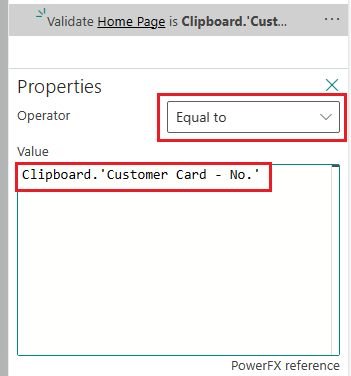
For the visible journey, Page Scripting records and replays actions, validates fields and dialog text, and saves YAML. It requires PAGESCRIPTING - REC and PAGESCRIPTING - PLAY permissions, or equivalent permissions. For pipelines, the guide documents @microsoft/bc-replay, Node.js and PowerShell. That player does not support MFA. The tool also cannot automate control add-ins or embedded Power BI reports.
The AL testing restrictions prohibit running these tests in online production. Online sandboxes prohibit large test volumes and methods exceeding 15 minutes; Microsoft recommends limiting testing to one or two hours daily. For large suites and CI/CD gates, it recommends container-based development environments.
Fictional example: a discount rule
This Nexo example is separate from the product's standard business logic: an extension applies a 5% discount at 10 units or more. The unit price is fixed at €100, excluding tax and other discounts. Quantities must be positive integers; zero is rejected. The table describes expected outcomes, with no actual test execution.
In this design, AL would check the calculation and rejection of invalid quantities. The recording would follow line entry and validate the visible values or agreed message. The team would prepare AL cases and a recording for those same criteria.
Fictional input
Expected AL result
Expected interface validation
9 units
Discount: 0%; total: €900
The line shows 0% and €900.
10 units
Discount: 5%; total: €950
The line shows 5% and €950.
11 units
Discount: 5%; total: €1,045
The line shows 5% and €1,045.
0 units
Validation error
The operation is rejected with the agreed message.
Nexo's interpretation: agreeing on acceptance
Our interpretation is that shared cases could help developers and functional colleagues discuss acceptance. We propose a small pilot with three explicit decisions:
Such a pilot would allow the team to assess whether both layers help discuss the same rule. A successful result would cover only the cases and journeys executed; it would not demonstrate complete coverage or replace human acceptance.
Agree on the rule, its boundaries and expected outcomes with the functional owner before recording.
Prepare reproducible data and an initial state in the chosen test environment.
Version AL cases and recordings alongside the change, retain results by case, and review failures before acceptance.
Created with AI assistance and reviewed by Nexo Community. Practical proposals and editorial interpretation are distinguished from documented facts.